Growing Up Jazz Part 1: The Biggest Lesson

The first time I sat down with Dara Roach, I walked out on her. I returned to the bar and grill in our Brooklyn neighborhood, but only after a much needed 30-second breather to digest the bomb she dropped on me, most casually between sips of her white wine. Up until this moment, I knew that Dara was a bright, beautiful woman with a magnetic smile. I knew she was, like me, a new mom looking to connect with like-minded local families, with a goal to further enrich our young toddlers’ social activity; the mission which brought us together that evening. All of this was more than enough for me to know she was a special person. That Max Roach was her dad…well, now, for this I wasn’t prepared.
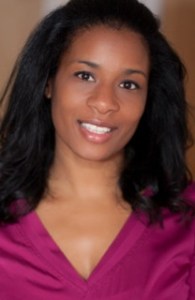
Photo Credit: Kelley Vollmer Bruso

Misunderstand me not, this information did not lend itself to superficial surmising, or anything ridiculous like that.  But we’re talking about Max Roach, who happens to be one of my biggest cultural heroes.  Though I had not known Max Roach personally, he was close to my heart, symbolically.  The social and political underpinnings of his artistic expression and his inventiveness as a modern jazz pioneer, place him as one of the most significant African American figures of the last century.  I, like so many others, had attended his memorial service at the Riverside Church in Harlem three years earlier, and shared in the huge sense of loss and love the world felt with his passing.

Dara forgave, understood and found the humor in my sudden departure, and it opened up a wonderful discussion about family, and all of the dynamics and nuances that only a jazz kid can relate to.  The daughter and niece of jazz musicians myself, I felt a bond with Dara which propelled our neighborly association into an instant kinship.  Jazz’ll do that to you.

Growing up with such a distinctive patriarch is one thing, but Dara’s mother is a beacon all on her own; an Emmy award winning journalist, author and historian, with the nation’s first graduate degree in Black Studies, to be more specific.  Abundant fruits of such a parental powerhouse’s labor seem inevitable, and evidenced by Dara’s impressive resume, they are.  In addition to having spent years as a television producer for CBS News, TVOne, and BET News, Dara is the co-founder of Mosaic Digital Media.  She also, along with her four siblings (including her twin sister, Ayo) handles her father’s estate.  The saying, “To whom much is given, much is expected” comes to mind when I think about the massiveness of the latter.  Dara’s admirable level-headedness about it all seemed rooted in her very upbringing.

“My father is a musician with a very intense social political perspective on everything; his music, his life,” says Dara.  “[Yet] we grew up in Greenwich, Connecticut.  We were born in the City, then quickly moved to Massachusetts.  And then when I was a little kid, we moved to Greenwich, pretty much during a time when we couldn’t even go to the Greenwich Country Club because we were Black.  So you’re in this environment where you really are a kid [who’s like a] fish out of water.  I used to call us The Addams Family, because outside of my bedroom door in this huge mansion was a picture of Malcolm X…and that was the kids’ wing [laughs];  Malcolm X and all of these important figures in African American history.  So it was interesting.  I was walking between two worlds very early on.”
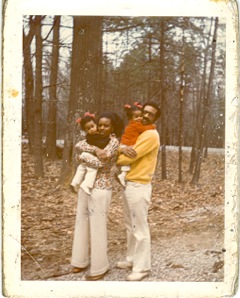
Dara with her parents and twin sister (courtesy of Dara Roach)

I’m not easily surprised to hear stories or experience incidents of modern-day racism, but I have to admit, I was taken aback that this type of legal, brazen bigotry had happened to someone in my peer group. And yet, it is Dara’s aforementioned calm demeanor about it which floored me once again.

“Because of who [my parents] were, so culturally identified, they realized this was something that has to change, and that bit of racism that we did feel was something they immediately discussed with us,” Dara explained.  “And even went as far as classism and racism within our own culture.  We weren’t allowed to be in Jack and Jill [of America].  And yes, we lived in the biggest house on the block, and [were] invited into these organizations…and nothing against Jack and Jill at all, but there were other Black families who were not invited because of their economic status.”  Being a child and dealing with such adult principals wasn’t always easy.  “Growing up with parents like that was kind of frustrating because every answer was no,” Dara reminisces with laughter.  “I wasn’t allowed to watch most TV shows, and thank God for The Cosby Show because that was about it!  But at the same time, they were trying to let us understand that we are who we are, we don’t tolerate discrimination, [and] we don’t tolerate any kind of generalizations…we just don’t tolerate it.”

The instilling of the level of fearlessness and confidence Dara describes, put the world at her fingertips, but professionally, Dara decided initially, she didn’t want any parts of entertainment. “It’s funny when you grow up around artists and musicians,” says Dara. “I remember when I first got into media, I was doing PA on film sets, and the question of whether or not I wanted to be in entertainment came up. But I wanted to keep my entertainment entertaining, and as long as you know these people and are behind the scenes, it’s not. I want be in a seat, in the orchestra, enjoying the show [laughs]. So I mean I love musicians, love my friends and family but sometimes you just wanna show up and be that wide eyed audience member, and not know that, ‘Well, this wasn’t supposed to be that way.’ So I said I’m going into news, which I did for many, many years… which is entertainment somewhat. It was a lot of fun, and now I don’t have a problem with it. I like the business of anything, whether it be music…. but at first I felt like I didn’t even want to be near it. I want to have fun, I want to enjoy it.”
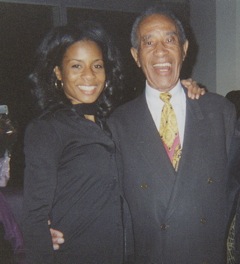
However, having such a paramount figure like Max Roach for a father doesn’t quite give one a choice when it comes to being “on the scene”, especially in the wake of their passing.  As Dara explains, an understanding of the business and a solid, impermeable family foundation make it easier to deal with being responsible for the legacy a parent leaves behind.

Dara & Dad (courtesy of Dara Roach)

“It’s important to know that the responsibility of your legacy is the artist himself. If you do not make plans for your legacy, and you just leave it in your children’s hands to figure out, you are in trouble. Going through this process, which we haven’t even started, is a lot, if you haven’t made plans. And this is sort of like a PSA to musicians. There are people out there to help you figure it out. All artists, do it now. My father kept every piece of paper, and he has an amazing collection. He said he wanted to keep it together. We are doing that.” In terms of how these insurmountable tasks are divvied up, Dara says, “He put my older sister, Maxine, in charge of that and she’s been diligent in documenting everything that he held on to. We all participate in different ways, but she’s been very diligent and helpful. She’s also been very hands on in terms of preserving my father’s archives. You can also find someone who can help you through the process but you always want to be informed, and I think we’ve gotten really well informed, and we work together as a team.”

Among the many ways Dara and I relate, I have also felt the pain of losing a parent.  My father was a musician revered for his brilliance as a trumpeter.  The dichotomy between parent or human being, and legend can be a difficult one to process, especially once they have left us.  However, the carrying on of a legacy, which is probably the greatest responsibility a child can have, can also be one of the most healing tasks.

“Always keep our institutions in mind.  I think we should always keep our institutions in the loop,” Dara says regarding the sharing of jazz musicians’ tangible history.  “Some of them are newer, or not as well endowed but figure it out, I think that’s really important.  You want to make sure that you keep them in the loop despite experts who may not say this because they want everything to stay together — but if we don’t support our own institutions, who will?”  Dara is making good on this imperative philosophy, working with, for example, the Smithsonian, whose National Museum of African American History and Culture is slated to open in 2015.

“As well, I’m personally working on his digital legacy,” Dara announces. “So we are working on a website that’s going to honor him and keep his name and legacy out there. I realize, [for example], how twitter has exploded. Now, through the digital world, you can bring in and aggregate everything on Max Roach, so people are doing YouTube posts, or around his birthday, you always see a Twitter or Facebook, or Pandora spike. So we’re working on a site that is going to feed all of that in, and be like a living legacy. So everyday, we’re going to feed it by letting people see what you wouldn’t normally see from his collection. I’m really excited about that specifically, because I feel that’s another way that families can keep the legacies alive.”

Dara’s active participation is not only out of love for her father, and those who loved him, but a fierce protection as well. “You want to have a system for dealing with the fact that people are going to need certain things, whether it is photographs, book requests… people want interviews, people are writing books, they want this and that, and it’s important to have that public space, because one of the things that we’ve realized is that we have a responsibility to help people understand who he was and be accurate and if we’re not accessible, if no one even knows who to contact….like the Smithsonian contacted me through Facebook, which is great, but you want to be able to make that accessible so that people don’t have to look so hard and so that he can participate in things like the African American Museum at the Smithsonian. So that his legacy is involved when they are doing a book on jazz and bebop. You want to make sure that, even though he’s not here, he’s represented, and represented accurately. That’s a part that is really important to us — to keep his memory alive, and keep it accurate.”

Though I never had the honor of knowing Max Roach personally, who he was as a man had always shown brilliantly through his music.  Now, I can see through the beaming light of Dara Roach, who he was as a father.  “The biggest lesson learned from my father was to never underestimate your value.  Never pigeon hole yourself.  Embrace who you are and what your potential is.  My father is a person who believed in me and my ability to do anything, and I think that’s because he believed in himself and his ability to do anything.  He didn’t become “Max Roach” because he decided that he was going to let anybody tell him what to do.  We didn’t live in Greenwich, Connecticut because he decided that he was going to take whatever you want to give him.  So that idea of not compromising and knowing your value is the biggest lesson that he gave me, hands down.”♦

Read about one of Max Roach’s most significant albums, We Insist!, in my discussion with Christian McBride for the “Message In Our Music” series.

A Message In Our Music Part 2: Christian McBride

Simply put, there are bassists, and then there’s Christian McBride.

With a career as a musician, composer, arranger, and producer, which began two decades ago, McBride has since set thee standard and captivated fellow musicians and audiences alike with his astounding technical superiority, his inventive, demiurgic vocabulary, and a sound which is as tremendous as the Philly native’s outgoing presence and infectious charm.  McBride is the most significant bassist to come along in the last twenty years, and is inarguably, one of the greatest to ever play the instrument.

In and outside of the jazz genre, McBride has collaborated, recorded, arranged for and performed with many of the most essential artists in the business: Freddie Hubbard, Sonny Rollins, J.J. Johnson, Ray Brown, Milt Jackson, McCoy Tyner, Roy Haynes, Chick Corea, Herbie Hancock, Pat Metheny, Isaac Hayes, Chaka Khan, Natalie Cole, Lalah Hathaway, Sting, Carly Simon, Bruce Hornsby, The Roots, D’Angelo, Queen Latifah, and Kathleen Battle.  You can also add the Godfather of Soul, James Brown, to this royal roll call.  (McBride is a self-proclaimed James Brown connoisseur and avid footage collector.  Don’t go there with the man.)

McBride has an illustrious recording career, with over ten albums as a leader, and his latest album, The Good Feeling (Mack Avenue), earned him a Grammy award this past week.  His first big band recording, McBride rallied an array of dynamic musicians including Steve Wilson, Ron Blake, Nicholas Payton, and Xavier Davis.

 McBride has a long history of making bold statements away from his instrument, an attribute which has resulted in the imploring of so many esteemed organizations and initiatives.  He spoke on former President Bill Clinton’s town hall meeting “Racism in the Performing Arts”.  His four movement suite, “The Movement, Revisited”, which is dedicated to civil rights pioneers Rosa Parks, Malcolm X, Muhammad Ali and Dr. Martin Luther King, Jr., was commissioned by the Portland (ME) Arts Society and the National Endowment for the Arts.  In 2005, he was also named co-director of the National Jazz Museum in Harlem.  Reminiscent of the protagonism of James Brown, McBride has an uncanny ability to use his musical stature to foster social awareness.  It was an honor to sit with him, especially for this particular occasion.

Check out our discussion about three of McBride’s most essential politically-influenced albums.

Sonny Rollins Freedom Suite

“Well you know, Sonny has been a master of his instrument and craft for so long,” says McBride.  “Particularly if you listen to Sonny in the 50s.  His sound, his vibe… everything about him was pure Harlem.  I bought this record when I was in high school… maybe 9th or 10th grade. The reason why I love the freedom suite so much [is because]…if you ask most Black folks our age, and maybe even a generation before, what the greatest protest album, or politically aware album is, they’ll almost always say [Marvin Gaye’s] What’s Going On.  And I don’t have a problem with that.  We all know that it’s an absolute masterpiece…an unquestionable masterpiece.  But I find that’s the only album most people know.  That was 1971.  Freedom Suite is 1958, and the jazz musicians have been ahead of the political/musical curve for a very, very long time.  The Birmingham bus boycott was only three years old, and to my knowledge, Sonny Rollins and Max Roach were the only two musicians from that generation really overtly dealing with it.  Even in Sonny’s liner notes, where he talks about the “American Negro”.  To think that Sonny was that aware, or jazz musicians were that aware and would make a record about it in 1958…that really says a lot.  And so we know that he was obviously very socially and politically aware and active but then the music, the piece itself…the Freedom Suite…man, that’s some of the greatest music ever.”

As likely with many of my readers, I have felt a sense of social and political abandonment in Black popular music and other artistic mediums, which is quite disheartening.  To think that we’ve “arrived” in any way, is a sadly misguided ideology, and one I believe to be very dangerous.  Struggle is not akin to weakness.  In fact, it is quite the contrary.  To me, struggle is action.  I asked McBride about this expression in jazz and whether or not this is something that has, as in popular music, been wiped from the musical dialogue.

“I think there are a lot of cats out there who are making some very serious music that is politically and culturally aware,” says McBride.  “It might not have the same impact as it might have in the 50s when it was still, relatively, an unheard of thing.  But I think there are some musicians now whose creativity is fueled by what goes on in our culture and our world.  People like Orrin Evans, Russell Gunn…I myself have written an opus which will hopefully be released this year on Mack Avenue.  I think there are a lot of cats out there who really know what’s going on.  How it would be accepted is another thing.  Because I think we’ve all gotten too comfortable.  And I don’t mean that in the sense that to be politically and socially aware, that necessarily means that you have to be angry, but you gotta at least speak up for what you believe needs to happen.  Like Nicholas [Payton] starting people talking again about Black American Music…and I whole heartedly agree with him 100%.  Especially with the part [about the] resistance anytime Black people want to claim something.  We take different approaches to how we convey the message, but the sentiment is exactly on the same page.”

 Max Roach We Insist!

I was really happy that Christian picked this album to discuss, particularly because of the presence of Abbey Lincoln.  As discussed with Jason Moran in Part 1, anytime a woman’s perspective can be added to the discussion of social justice in America, it is to the benefit of everyone.

“I got to play that piece once with Branford Marsalis; it was me, Branford and Brian Blade,” McBride reminisces.   “That was so much fun.  But anyway, Max is on the Freedom Suite, and Sonny of course, was in Max’s group with Clifford Brown in the 50s.  Once the movement really did become “The Movement”, Max Roach was there early.  Max was very outspoken; he was very politically active in the movement before it caught fire.  He and Abbey.  When you hear Abbey Lincoln singing “Driver Man”…she’s another one.  When it comes to the civil rights era, music and black females, sadly, I think she unfairly gets overshadowed by Nina Simone.  But Abbey…you’ve got to give her her props.  What she and Max did together for many, many, many years — not just on We Insist! either — was very much ahead of its time and very influential on a broad scale because we all know Max was tight with Harry Belafonte and Sidney Poitier, and Dr. King, and the Black Panthers later on.  Max Roach was actually part of J.Edgar Hoover’s file cabinet; somebody did a story about that a few years ago.  He was being followed by the FBI.  Max was deep, deep in it.  So an album like We Insist! really puts it in perspective.”

Duke Ellington Black, Brown and Beige

Since Black folks came to this country, I suppose the issue of approach to our freedom has been a debated one.  During the civil rights era, the level of militancy neccesary was a constant debate, and what is deemed “militant” was another.  Even in music, this has been and still is, a point of contention.  Here, McBride illustrates how.

“There was an interview that Duke did for a Black newspaper in the late 60s, and the writer asked Duke, ‘Well how come you don’t write music for the people?’  The arrogance of youth, [laughs]!  And Duke, in his usual, classy, elegant and sophisticated style says, ‘Well I think I address those issues with Black, Brown and Beige’, and the guy says, ‘Well, what is that?!’

I have a hard time believing anything considered modern or…when you look at how we’ve evolved allegedly as a people, it’s hard to think that we made strides that Duke Ellington hadn’t already made long before anybody was even thinking about stuff like that.  You look at Duke Ellington’s music from the 20s, through the 30s, through the 40s…Duke was always addressing the beauties, the victories and the pains of Black folk.  Always been there, always.  So Duke was very much a role model and an example of someone who understood that he had a greater responsibility than to just write good music for his band.  He was always about the cry of his people.

Duke was always somehow able to express and convey the feelings of Black folk without being angry.  You could feel the sadness, pain, angst, but it was always done through this filter, this lens of triumph in the end… or hope.  I think that’s what separated Duke from the rest of the pack.

Now, speaking of this album specifically, you’ve got Mahalia Jackson.  These are two titans arguably at the peak of their powers collaborating together.  When you talk about fusion, to my knowledge, I can think of no greater example of one of the earliest collaborations of jazz and gospel. I know Milt Jackson and Ray Brown did it with Marion Williams in the 60s, but Duke and Mahalia…it gets no better than that.”♦

Listen to Dee Dee Bridgewater, Cassandra Wilson, and Dianne Reeves sing “Freedom Day” in honor of Abbey Lincoln on JazzSet live at The Kennedy Center.

Growing Up Jazz: An Inside Look at Family & Music

It’s Black History Month!

 Photo by Angelika Beener

Though television programming which celebrates Blacks throughout the month of February has gotten leaner and leaner each year, and an increased amount of savvy and investigative skills are required to find ways to observe the 29 day spotlight, I hope to be doing my due diligence here at Alternate Takes via a couple of very special series.  I’m really excited to share this one with all of you.

Black history is both perpetual and personal, and we can look at the history of Blacks in America from the broadest or most intimate of lenses.  In this next series, we are going deep into the heart of the music, with Growing Up Jazz, a unique look at the family dynamic of a jazz musician, through the eyes of his children.

We learn the most about jazz musicians through their art, as it should be.  The music, after all, says it best.  However, the music industry, critical analysis and brand marketing tend to dehumanize and disconnect him or her from the element that likely inspired the very art we hold so sacred — the family.  The edification of family is not often the first thing to come to mind when most think about a jazz musician; drug abuse and other ramifications of societal dysfunction are more accessible concepts, founded or not.  Yet, the family is and always has been a great source of inspiration and strength to jazz artists.  We’ll explore just how.

It’s coming soon!  In the meantime, Part 2 of A Message In Our Music continues this week, with the unparalleled Christian McBride!

A Message In Our Music Part 1: Jason Moran

Courtesy of Jason Moran

After assimilating the phenomenon which is Jason Moran, his eminence in music is even more mind-blowing once you consider the fact that he is just 37 years old. In addition to receiving just about every award, acknowledgement and accolade within the jazz spectrum, he is also recipient of the 2010 MacArthur fellowship, and has just recently filled the imperial shoes of the late Dr. Billy Taylor as the Kennedy Center’s Artistic Advisor for Jazz. Leading one of the most relevant and longstanding piano trios of our time, Moran has also performed and recorded with contemporary and legendary artists like Greg Osby, Cassandra Wilson, Steve Coleman, Sam Rivers, and Charles Lloyd. He’s a special guest on drummer Jack DeJohnette’s new release, Sound Travels; a stellar album with an array of artistic powerhouses like Bobby McFerrin, Esperanza Spalding, Lionel Loueke, and fellow Manhattan School alum, Ambrose Akinmusire. (Moran also produced Akinmusire’s critically-acclaimed Blue Note debut, When The Heart Emerges Glistening.)

His impressive resume aside, Moran’s influence as a pianist and composer is tremendous. The Houston native’s love for the visual arts has led to exciting and deeply resonant endeavors. It was a no-brainer for me to implore Mr. Moran’s participation for this project and it created a special opportunity to explore the mind of the man who is, as Rolling Stone magazine puts it, “shaping up to be the most provocative thinker in current jazz.”

Check it out, as Moran and I share some of our thoughts based around three pivotal social albums.

Charles Mingus Ah Um

“Mingus is…I think he’s related to me [laughs],” says Moran when asked about his decision to pick this album as part of our discussion.  “Only because I studied with Jaki Byard.  That’s how I think of my family.  Jaki Byard makes a lot of other people my relatives because I was really under him.  So, considering that Jaki was playing with Mingus was when they were playing much of this political music, I always think about what Mingus represented as sort of a much more hard-edged Duke Ellington, you know?”

An artist who has brilliantly utilized multi-media platforms to express himself as a musician, it’s no surprise that Moran would rely on more than the music to impact his students when teaching a master class at Manhattan School.  “I showed 45 minutes of [an episode of the PBS series] Eyes on the Prize.  It was the episode when they discuss the Little Rock Nine in Arkansas and Governor Faubus and…how crazy he was.  So I showed them the film for about 45 minutes, then at a certain point I just turned on a live version of “Fables of Faubus”.  It was around 12 minutes long…and then I watched the students react.  Because [for] most of them, “Fables Of Faubus” is just words or something that maybe Mingus made up.   There was a student from Finland in the class, and he said after watching it and listening to Mingus’ song, ‘Well, now it makes a lot more sense.  Because being in Finland, my friends and I used to always wonder where that energy came from.’  I said, ‘Yeah, exactly.’  This is an entire segment of the population whose life is dealing with stuff like this.  And we’re just watching an edited excerpt of people’s everyday lives.  You can’t imagine what that does to a population mentally and physically.  And we’re still trying to cope with all of that…even now.  So it broke down a lot of people’s understanding of society and the affects it has on music.  That everything is not just about a chord, or a melody or the greatest groove…it wasn’t about that.  It was therapy.  People were using the music as therapy.”

“You know, sometimes I go to these museums all around the world and they have portraits from the 1600s and 1700s, during the Victorian era [etc.].  Bunches of portraits…so we kind of get accustomed to seeing portraits of people other than us.  And in music, it doesn’t exist in the same way, but it’s part of the reason [my wife] Alicia and I are embarking on writing a series of portraits for artists we know, most of whom are African Americans, because for me, as a composer, I mean, I’ve written a song for my parents, and my family in Texas, but wow, maybe I should continue trying to explore that even further because what if you started to document your community?  Photographers document their community, writers document their community, or you’re doing it right now through an interview.  And musicians, what do we document?  How do we document our lives and the people who are around us?  That’s how you kind of put a date stamp on where the population is.  You take that moment to snapshot everything that’s around.  So Mingus does that.  He snapshots how crazy America is in the 1950s and 60s.   People won’t know that history so frequently, but here we are still talking about it.”

John Coltrane Live at Birdland

Personally, I will never forget the first time I heard John Coltrane’s “Alabama.”  It was haunting and spiritual on impact, way before I would learn of the gruesome events from which the song is inspired.  Spike Lee transports us to the height of tension in the Civil Rights movement in Malcolm X, when the song is a backdrop to footage of the brutal Jim Crow South, where four black girls Addie Mae Collins (aged 14), Denise McNair (aged 11), Carole Robertson (aged 14), and Cynthia Wesley (aged 14), were killed in the bombing of the 16th Street Baptist Church in Birmingham, Alabama.  Written and performed by Coltrane just weeks after the tragedy, I have often wondered about how he dealt with something so devastating, so I was very excited when Moran suggested we talk about this album.

“I was at an event at Princeton and there was a panel discussion of SNCC (Student Nonviolent Coordinating Committee) members,” says Moran. “They were talking about how crazy it was to be down there in the South. Some of them were from up north and someone asked if there was a difference between how racism feels up north, versus how it feels down south. The panelist said the first day he got down south he was driving from the airport, and a cop pulled him over and told him, ‘I know why you’re down here, you need to get out of here.  You’re down here to make trouble.’ And that cop is not only the cop, he’s the sheriff, he’s the mayor, he has the biggest businesses in town. It was that massive and overwhelming sense of danger. Also, Nasheet [Waits] gave me some interviews of Kenny Clarke, and he’s talking about being down south with Louis Armstrong. When he got fired by Armstrong’s manager, they just kind of left him down in Georgia with his drums. A black cab driver was like, ‘What are you doing down here, you better get in this car’ and he took him someplace where Kenny was able to find his way back north. I mean, you can’t actually imagine this kind of trauma that people were feeling personally, and as a community. Then put it in the context of hearing about this bombing when Trane plays that song up North in New York…it’s like a hymn or a low moan. It’s impacting, it’s mourning, it’s most dark, you know? This is something real. It’s something prominent and it sounds like this. And it’s a collective moan of African America at that point.”

Nina Simone Live in Concert

Nina Simone is someone I was late to discover. Growing up, I was enthralled with the “singer’s singers” of jazz, and had not really given much thought to the magnitude of Nina Simone until I had, as my elders would say, “done some livin”.  Now that I have done just that, and more specifically, become a mother of a son who will become a Black man in America, the significance of Nina Simone in my life has increased exponentially. Moran suggested we talk about this album in particular because of “Young, Gifted and Black”, which for me,  feels more like the Black National Anthem than the actual one. It is the anthem which spoke to the time, and I think this makes it personal to me.

More from Moran…

“Sometimes I think the stylist — and there are lots of stylists within this canon — they change the context of the songs that they’re playing.  So Art Tatum adds all this dazzle and this sparkle and just feels like…I don’t know, like these really intricate chains from West Africa, you know?  Like these amulets of gold that kings and queens would wear, and now he’s paying a song like “When Sonny Gets Blue”, and he’s adding all of this to it, which is not there when the composer wrote it.  Same with someone like Earl Hines, where he’s adding these chords. So Nina is the same way. She sings these songs, and she’s totally changing the context.  Certain songs never sounded so real and pertinent to African Americans until they came out of Nina Simone’s mouth. You feel like it’s talking about your experience, so I think in a way, those kinds of artists also curate the kinds of songs that they think may have an abstract relationship to something political, but then she also does this boldly by writing these other songs. So here are these songs that honor these great people like Lorraine Hansberry with “Young, Gifted and Black”.  It’s a statement that marks the time in which it was written and Black Pride is kind of at its peak in the movement. So even the use of the word “Black” puts a date stamp on where we are. I remember my grandmother being in quoted in an article where she says she was colored, negro, black, and African American, all in one lifespan. So it date stamps it, which I think is just so important for the form. That you can look at the lexicon of African American songs that way. And also Nina as a pianist and how she accompanies herself, the kinds of chords that she uses, and how those sounds mix with the timbre of her voice…she was just unique all the way around.”♦

Watch a clip of IN MY MIND, the feature length documentary of Jason Moran & The Big Bandwagon’s take on Thelonious Monk’s Town Hall recording.