
The first milestone! One year ago this month, Alternate Takes was launched. After going over it in my head, waiting for timing to meet opportunity, I finally decided to add my voice to the much needed conversation about musical, social and political ideas, with jazz as the nexus. One year ago, I would not have imagined how well it would be received (thank you!), and how many lessons I would learn from my generous subjects. In honor of Alternate Takes’ first anniversary, I’d love to share some highlights, and favorite moments thus far.
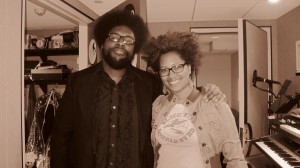
Ahmir & Angelika
My first interview for Alternate Takes was with Ahmir “Questlove” Thompson of The Roots (can’t beat that inauguration, huh?) My main objective was to speak with him about the Grammy category cuts, which had just occurred. Although this was the focus of the interview, Ahmir is a person who has so much knowledge and wisdom that you just want to have your listening ears on all of the time, or you’re sure to miss something edifying. One of the great music minds of a generation.
 Speaking of wisdom, the interview which author and scholar Robin D.G. Kelley graciously granted me about his Thelonious Monk biography is another one of my favorites. A lot of that certainly has to do with inescapable Monk sentimentality on my part, but so much of it has to do with Kelley’s brilliance in bringing Nellie Monk to the conscience of anyone who claims to be a jazz scholar, with his re-imagining of what it means to be a woman in jazz. On my quest to write critically about jazz, there is no shortage of seasoned writers to model after. However, I want to model after the great ones, and Kelley is a leader of that esteemed and very small pack. Geri Allen speaks about the importance of a broader spectrum of writers in our interviews also – another pinch me moment!
Trumpeter Nicholas Payton has emerged as one of the most important voices off of his instrument. I was grateful to talk to him last May for Alternate Takes. This was pre-Black American Music (BAM) movement, of which he is at the helm. It is my feeling that it’s very special to capture a person’s mind at the burgeoning stage of whatever they are producing, and I was able to do that with Nicholas, so I really cherish .
 I’ve spoken several times about the significance my mom has had in my life as the first woman jazz enthusiast I’d been exposed to, and it an honor to interview her for the Growing Up Jazz series, along with Dara Roach. It was also really fun doing the Mother’s Day playlist for her, which I think will be an annual thing. You guys seemed to really enjoy that.
The Drummers Who Compose series was one of the most enlightening journeys for me. As open and exposed as I like to think I am, it was most eye-opening to learn about the process of composition from master drummers Adam Cruz, Kendrick Scott, E.J. Strickland, Ari Hoenig, Eric Harland and Johnathan Blake. I received a lot of great feedback from this series, and even some requests of other drummers you all would like to see covered. The next instrument in the series is going to be bass, by the way, so look for that in the months to come!

Photo by Gianina Ferreyra
A big part of the goal with Alternate Takes was to showcase the younger generation of movers and shakers in the business. For this reason, interviews with Ambrose Akinmusire, Gretchen Parlato, Marcus Strickland, and Kris Bowers were a joy. Their ideas, passion and commitment are powerful forces in this music, and I hope you will continue to support them. They are game-changing, inspiring artists. If you missed their stories, please check them out.
If you’re a true hip hop head, it does not get any better than talking to a member of A Tribe Called Quest. Last year, their seminal The Low End Theory hit its twenty year milestone, and I had the honor of talking to Ali Shaheed Muhammad about this and a whole lot of other subjects, like the group working with Ron Carter. What a gracious interviewee.
This year kicked off with A Message In Our Music, and having Jason Moran and Christian McBride to talk to about socially conscious music was honestly a dream come true. The level of intellect and accessibility these men displayed turned my blog into an amazing classroom. I learned so much, and I think a lot of you did also.
With so much to talk about from over the last year, it’s daunting to think about matching it, but it’s my promise to all of you (and myself) to do so this year. 2012 has started off just grand, and this month I’ve ventured into the scholarly world, guest speaking at the University of Pennsylvania, at the invitation of the brilliant Dr. Guthrie Ramsey. I spoke with both he and the mind-mezmerizing Dr. Shalamishah Tillet during their Jazz Is a Woman course. What a thrill! The inspiration of the students is something I can’t put into words… yet. I’ll be looking to do more of this type of work, and I’ll be keeping you posted on it. You can still find me over at Nextbop as part of their talented team, as well as other jazz publications, contributing editorial. For Alternate Takes, sending you all a huge thanks for your readership, involvement and support. Onward!
Truly,
Angelika


 ALTERNATE TAKES