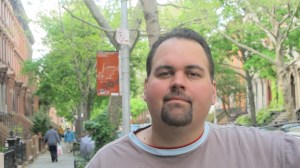
Josh Jackson of The Checkout
When you visit jazz music magazine, The Checkout on the web, you don’t feel like you’ve time warped five or six decades into the past. You immediately feel like jazz is fresh, vibrant, now — and cool. But this isn’t some manipulation or illusion; it’s just an accurate depiction of what’s really going on. Finally.
Josh Jackson, creator and producer of The Checkout, which airs on WBGO-Jazz 88.3 FM, is the man behind the music. He has taken his passion for music and partnered it with his extensive radio experience and tech savvy, to bring modern jazz into the forefront of the multi-media world we’re submerged in. The Checkout is a one-stop-shop and a jazz lover’s haven for exclusive content via interviews, live studio sessions, playlists and podcasts. No where else can you hear/see an in-studio session with Brian Blade, hear Esperanza Spaulding discuss what’s on her iPod via Shuffle, view a live twitter feed, and hear Sonny Rollins discuss his experience living blocks away from World Trade on 9/11 — in one place. I put Mr. Jackson on the other side of the microphone to ask what he set out to do differently when conceptualizing the program. His answer? “I think what I wanted to do, is what I still want to do, and that is cover the [jazz] scene the way it is.”
This may sound simple, but jazz music is perhaps the most complex art form there is in terms of identity; the past and present, both needing and fighting each other at the same time. Nostalgia versus stagnancy. Labels and definitions being oxymoronic, or much-needed boundaries in how the music is created. All of these sensitive subjects can make it difficult for a responsible broadcaster to produce and deliver. Jackson strikes an impressive balance in this area, and is creating a loud buzz in the jazz community and beyond.
 Jazz has lacked proper exposure over the last few decades, and newer artists have suffered the most. Jackson seems to have a need to make up for lost time. And while The Checkout has unfailingly featured jazz music’s greats and legends, the program is an unsurpassed platform for artists just stepping into their own. “I don’t advocate for The Checkout being all of WBGO; The Checkout is one hour in a week of WBGO programming. But I do advocate that WBGO, and any other station in any other market, consider having a show like The Checkout, so that there is a space on the dial in whatever market, where you can see the musicians that are operating today, no matter what age they are,” states Jackson. It is this kind of thoughtful balance that lends to The Checkout being a show for everyone. “There is a great audience for jazz, despite what people tell you. [It is] fragmented and scattered, and so my job as a broadcaster is to find the net that’s gonna catch all those fragments in all those places. And cumulatively, I do believe that it’s a bigger audience than what a lot of research would tell us. The interesting thing about The Checkout is that it has an incredibly diverse audience, demographically.”
This diversity is perhaps one of the greatest achievements of the program. The debate between the generations has classically been one about “whose jazz” matters and whose lacks relevancy, with the younger breed of musicians often becoming frustrated with constantly fighting the ghosts of jazz past. Jackson diffuses this pointless fire by not making a case either way, letting the artists speak for themselves — all of them. “I’m not a critic,” says Jackson. “And I also don’t have that sort of critical stance of separating art as some kind of object to look at and to study. I mean, that’s a very Euro-centric way of assessing criticism and so I know I’m not that.”
Not that, but who Jackson is, is an award-winning producer of several documentaries, with more than 250 live concert recordings under his belt. He’s also co-founder his own media company, and a main contributor to National Public Radio’s NPR Music. However, you won’t find any trace of pretentiousness, which is a valid stigma that the storytellers of jazz must face and fight to eliminate, as many people have accredited the elitist attitude within the jazz community to the genre’s declining audience. “You have to deal with people who aren’t fans the way an insider is a fan, and you have to connect with them on their level sometimes,” Jackson explains. The human connection that Jackson has made his broadcasting mantra, has served the program well, as aficionados, casual listeners, and newcomers alike, can all enjoy The Checkout equally. Jackson’s being tapped in this way, has informed several of his endeavors. Most vividly, Live at the Village Vanguard.
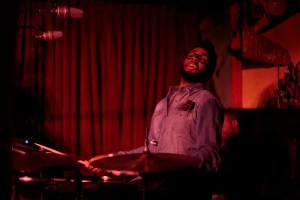
Photo of Jamire Williams by John Rogers/WBGO
A joint venture between WBGO and NPR Music, Live at the Village Vanguard is a program which brings the complete live jazz experience into the homes and laptops of the world, giving them first-hand insights to these concerts with live streaming both on the radio and online. Participants can also chat live and watch a live video stream of the concerts. The nature of interplay and interaction in the jazz ensemble inspires a similar intercommunication on the side of the audience. Jackson, who is a huge fan of both the club and the live recordings the Vanguard has historically released, is proud to call the Vanguard home. On being able to pull off something of this magnitude, Jackson enlightens, “One of the things I think I know about media right now is that there are a lot of ways that people are accessing content. Now we have the technology and now we have a generation behind me of digital natives, who…This is what they know: that all information is available any time, and so we’ve got to keep up with that. For a place like WBGO, still the biggest part of the pie is the FM transmitter, but at the same time there are people who are streaming the signal online, and accessing it on their mobile device. The cost in the technology is what’s going down. Now there’s the ability for a place like WBGO, who doesn’t really have a lot of money to invest on the technology end, to do streaming video, and to incorporate a chat so that people can communicate with each other while the music is happening. And also I think that aside from You Tube, jazz has suffered in a lot of ways since maybe the 1960s in not having a lot of exposure on the video side. You know, it’s one thing to listen to a record; it’s another thing to watch a performance and to hear musicians reacting to each other.”
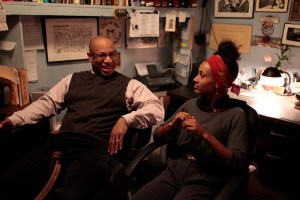
Otis Brown III & Esperanza Spalding backstage @ Vanguard (by John Rogers/WBGO)
Jackson is just as deft at exploring jazz musicians as people as he is at showcasing their talent. And it makes sense that I find Jackson as interesting as his program. But what drives Josh Jackson? “…I think I wanna know who these people are, you know? Because my experience has been that they’re all…they’re all interesting people in some way. I wanna know more about the people who do this and what their thoughts are, and also to connect with them on some way that I can connect with them. I can’t play like Wayne Shorter; I can’t write like that, you know? None of that stuff. But also, he’s a human being and so are our listeners so if you’re just willing to listen to what someone has to say, typically you’re going to find some kind of connection on a level that you may not have expected. And that opens up a whole new way to hear things, sometimes. I mean, the best interviewer is a listener. I go in with maybe a handful of questions that I kinda want to get to at some point, but I don’t have like this kind of grand design…plan, about how this thing needs to happen. I’m always thinking about the listener when I’m interviewing somebody. I’m thinking about somebody who’s meeting so-and-so, for the first time…and sometimes that someone is me, too.”
In my opinion, what The Checkout illustrates best is that the more we tell the truth about jazz, the more interesting it is. And the truth is, jazz is not one dimensional and encompasses more than some will allow in their own minds. Now, I am a firm believer that jazz is not “whatever you want it to be”. I’m not that liberal. But I do believe that the genre has room for everyone who is making music within it. And it’s a lot of people.
“The point of The Checkout I think is that it’s for everyone,” Jackson concludes. “The only thing you have to have is a willing ear, and you have to be willing to listen. It’s a show for listeners.”
And we’re listening.
——————————————————————–
One of my favorite segments of The Checkout is Shuffle. Jackson has his guests place their iPods on shuffle mode, and discuss the first 5 songs that show up in an attempt to gain further insight about the musician and how what they listen to may inform their own artistry. “People for the most part have fairly diverse listening habits. And yet, maybe not as wide as a lot of jazz musicians,” Jackson suggests. “So there’s ways of introducing the audience to some things they’ve never heard, and I’ve never heard.”
I played the game myself in honor of my interview with Mr. Jackson. Here’s what popped up in my iPod!
Angelika’s Shuffle List
“Morgan the Pirate” by Lee Morgan from Search For the New Land (Blue Note)
“Giant Steps” by John Coltrane from Giant Steps (Altlantic)
“Lift Jesus” by Kim Burrell from Everlasting Life (Tommy Boy)
“Valse Triste” by Wayne Shorter from The Soothsayer (Blue Note)
“My Little Brown Book” by Duke Ellington and John Coltrane from Duke Ellington & John Coltrane (Impulse!)
The Checkout airs on Tuesday evenings at 6:30pm on WBGO/Jazz 88.3 FM and on WBGO.org
 ALTERNATE TAKES