A Playlist From My Mother

My Mum

When people get to know about me and about my passion for music, they usually think it stems from the influence of my father being a jazz musician, or because I had a jazz icon for an uncle.  While these are facts, and while there is no doubt that these fortunate circumstances informed and infused my life and DNA, it is my mother who was perhaps my most important musical influence, and largely in part, the reason I do what I do.

My first recollections of any music are songs my mother played on the record player.  Growing up in the Bronx in that big apartment with unparalleled acoustics, those songs would permeate my soul and literally hit me right in the gut in the best way imaginable.  My mom is a very spirited lady to say the least, and music was her outlet and her love.  She would dance and sing all of the ins and outs to every tune.  So much so that I would always know which parts of a particular song would tickle or move her the most, and I think she got a kick out of the fact that I studied her.  Whether it was the first line of the B section of Monk’s “Little Rootie Tootie”, or when Marvin Gaye’s “Save the Children” would brilliantly segue into “God Is Love”, I knew all of her favorite little spots and would tease her predictability, much to her delight.

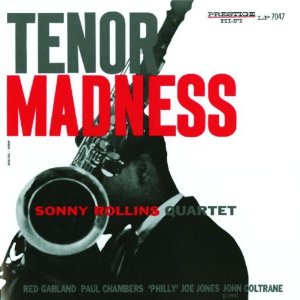
It was my mother who was the first woman jazz enthusiast I knew, which was probably the single most impactful part of her persona on my life.  She could scat, and she could sing, and she is the funniest mimicker of some of jazz  music’s rarest personalities.  She is also a great debater.  She and my step-dad would have a never-ending argument over who “won the battle” between Sonny Rollins and John Coltrane on “Tenor Madness”.  She voted Trane, and would quote the various aspects of nastiness in his solo to make her case. (She loves Sonny too, just for the record.)

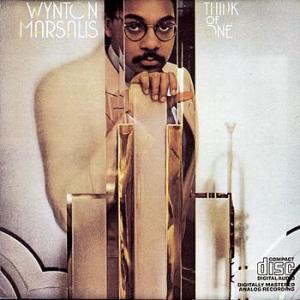
She had a very vast album collection, and she would play an array of Black music.  From Aretha Franklin to Ray Charles to Stevie Wonder to Joe Williams to Michael Jackson to Bobby Womack to Dinah Washington, we heard lots of music.  I remember her talking about a “young cat”, Wynton Marsalis, who was taking the jazz scene by storm when I was a little girl.  It’s also one of the most vivid album covers I can remember her owning.  Growing up in such a lively, musical household was of great benefit to my siblings and I.  We were steeped in our African-American heritage in a way that many of our peers were not.  My mom always let us know that this was music that we should be proud of, not by making some big jazz history speech, but by the sheer joy it brought her.  It was completely infectious.  I immediately loved this music, and she nurtured that love.  I’m certain that the gift of passing down this tradition is what made me want to pursue a career in jazz, which was always cool with her.  Starting out in this industry meant paying a lot of dues (which included sometimes earning little money) but the sacrifice never concerned her.  She was down for the cause, and I will always be grateful to her for that.  And for the music.

In honor of my Mom, I’d like to share a playlist I’ve dedicated to my mom with all of you.  This is the list of albums that most vividly speak to my formative years.

Mom’s Playlist

Aretha Franklin – Young, Gifted and Black (Atlantic)
John Coltrane – Ballads (Impluse!)
Ray Charles – The Genius of Ray Charles (Atlantic)
Marvin Gaye – What’s Going On (Motown)
Sonny Rollins – Tenor Madness (Riverside)
Stevie Wonder – Talking Book (Motown)
Thelonious Monk – We See (Dreyfus)
Lena Horne – The Lady and Her Music (Warner Bros.)
The Jacksons – Destiny (Epic)
Dinah Washington – Dinah ‘62 (Roulette)
Wynton Marsalis – Think of One (Columbia)
John Coltrane & Johnny Hartman (Impulse!)
Michael Jackson – Thriller (Epic)

This one’s for you, Mom!

The Grammy Cuts (Its figurative nose, perhaps?)

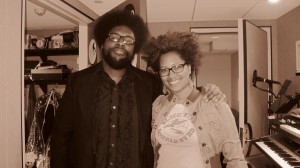
Ahmir & Angelika

The recent decision by the National Academy of Recording Arts and Sciences to cut 31 Grammy categories has received deserved backlash and reaction from the Black and Latino communities.  The cuts have limited the cultural diversity of the Grammys and include the loss of categories like Best Contemporary Jazz Album, Best Rap Album and Best Latin Jazz Album along with slashing the R&B and Instrumental categories in half.  When I first read about this in the New York Times a few weeks ago, my feelings went from disappointment to rage when I learned that the cuts came after an “open letter” from former record exec Steve Stoute.  He claimed that “the Grammy Awards have clearly lost touch with contemporary popular culture,” and makes his “case” by citing shake-ups in big categories within the last few years  — two of them being victories of Jazz artists.

So, let me get this straight.

The Grammys is a popularity contest?  Excuse me, Mr. Stoute, but I thought the Grammys was at least posing as the authority in recognizing great MUSIC…not popularity.  I thought the MTV Awards covered the popularity contests.  And what’s even more perplexing is what I hope to answer here: Why would a Black man single-handedly spearhead a campaign to stunt the recognition of Black music? Eminem, Kanye West, and Justin Bieber (losers to Steely Dan, Herbie Hancock and Esperanza Spaulding, respectively) are talented artists, but is a temper tantrum on this level the answer?

Before DJ Jazzy Jeff and The Fresh Prince won the “first” Grammy for a rap album, it was Herbie Hancock who won the 1984 Grammy with “Rockit”.  Mr. Hancock put hip-hop, break beats, and this type of Black culture on the major music map.  Having an artist like Hancock introduce hip-hop to the Grammy stage would prove to be of great benefit to the hip-hop community.  I would love for Stoute to explain how Hancock’s 2008 win over Kanye West is a demonstration of losing touch.

While Stout and the Grammy association are trying to make a claim that the cuts give the Grammys more exclusivity and credibility, it looks more like the same tired ass story of money and business as usual, with “special interests” being the motivator.  For certain artists, this could mean never (or never again) being artistically recognized on the level of a Grammy.  Ahmir Questlove Thompson’s initial reaction?  Two words: “It sucks.”

“I mean it’s a travesty because nine of those categories are what I was eligible for,” Thompson explained.  “There’s no more Best Rap Album, there’s no more Duo/Group category for hip hop…there’s none of that stuff so I don’t know…where that leaves me.”  This symbolic rug being pulled from under Thompson and other artists with tremendous artistry, talent and fan base, but perhaps a lack of uber commercial success, are finding themselves in the same precarious position overnight.

Thompson, who has hosted an annual Grammy jam session with The Roots on the eve of the Grammy telecast for the last several years, suggests that the problem has been misfired at the amount of categories, and the real issue may lie elsewhere.  “If anything, I would like to adjust the voting.”   He went on to tell me about an experience he had at the 2008 Grammys, when he was sitting with a group of artists in the Latin category.  Singer/songwriter Jose Feliciano swept most of the categories, to the frustration of many of his contemporaries.  They argued that Feliciano continued to be a thorn in their side because he was the most recognized name on the ballad; that he was winning on his familiarity and not necessarily on musical merit.  “In 2009 when I got my ballad and I was looking at the categories that I don’t know, you know I found myself actually validating that whole issue.  I think if there has to be an adjustment made, I wish we could sort of make it like the Mercury Prize in Europe or like how Canada’s works. There’s a jury…a jury of knowledgeable music snobs, bloggers, musicians…a jury of people that vote on a particular category and they’re very knowledgeable of it.  I think that’s a better adjustment for the awards.  It’s sort of like a license.  When u get your license, they’re not gonna let my C Class license drive…they’re not gonna let me operate a bus or a truck. They won’t let a vegetarian judge a Texas rib contest and I don’t think that certain industry people should just have access to certain categories that they just mark off.”

Agreed.  It seems as though Stoute got it way wrong, and the consequence is more than what he bargained for. “Since your complaining, Steve Stoute, we’re gonna take all your candies and cookies away,” Thompson illustrates, describing the frustration he suspects NARAS had with Stoute’s whining open letter. Stoute’s rant over who is and isn’t Grammy worthy, arguably caused an important balance of Blacks and Latinos to go down in the flames of never being acknowledged in music’s “highest honor”.   Way to go.  The affects of this decision are too early to predict, but the message that says artistry plays a back seat to economics is loud and clear.  “But you know, it’s like half these people aren’t necessarily doing what they do for any monetary award but the occasional annual pat on the back [from the Grammy committee] would really be nice.”

It would be nice, and it would be right.

Thompson ends our conversation on a lighter note.  “I’m producing [Jimmy] Fallon’s comedy record, so thank God that [category] hasn’t been touched!”

Nellie & Thelonious — A Love Supreme

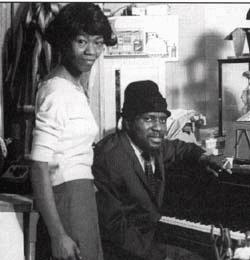
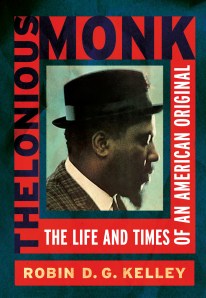
In the recent and definitive biography of Thelonious Monk, author Robin D.G. Kelley describes the jazz icon’s’ relationship to his wife Nellie as true love personified; something that is seemingly rare between Black folks, if you let jazz “historians” tell it.  Black love, and Black women in particular, have been calculatingly omitted from the history of jazz as lovers, wives, caregivers, and backbones of the art form.  Mrs. Monk is no exception…that is until now.  In Thelonious Monk: The Life and Times of an American Original, Kelley seems to purposely set out to straighten the record.  “There would be no Thelonious Monk without Nellie,” he plainly stated in our recent conversation.  “That is the most important fact I took away from the decade and a half I spent working on Monk’s biography.” 

In Thelonious Monk, Kelley debunks, and clarifies several myths that have been perpetuated about Monk, his music, his mental condition, and his capabilities as a musician.  But perhaps most intriguing is the amount of care and depth he takes in re-introducing Nellie Monk to the history of jazz.  Further, describing Thelonious as a “committed father and family man”, Kelley expounds upon the nature of their relationship which included a romance of over forty years, marriage, children, family and one of the most unique bonds in jazz.

I could not have been happier and more thankful for Kelley’s emendation.  While the media and implausible journalism have gone above and beyond to place Mrs. Monk in the shadows of Pannonica de Koenigswarter, (“Jazz Baroness” and close friend of the Monks), Kelley deflates the fantasy that Thelonious and Pannonica were ever romantically involved or that she was a savior or sorts.  I still find it curious that writers and critics devote so much ink to the support Monk enjoyed from the Baroness and yet barely mention Nellie.”

It is my feeling that we can chalk this attempt and so many others up to America’s incessant need to display the relationship between Blacks as anything but coherent, most devastatingly, on the subject of love and romance between man and woman.  Throughout history, we have seen Black men forced to fight to legitimize not only their own manhood, but also their love for their women.  In music, we see one of the greatest examples of this in Miles Davis’ beautifully audacious move to insist that the women who would grace his album covers be Black, in a time where Black women were not only fighting to be a recognized standard of beauty, but also fighting against a stigma that said they were not even desired by their own men, but second best to White women.  However, it is clear that Thelonious not only adored Nellie, but if we let the music speak, he certainly thought highly of Black women, and cherished his family.  In addition to “Crepuscule With Nellie”, his love ballad to his wife, Thelonious endeared his music to his sister-in-law, niece, and daughter with tunes like “Skippy”, “Jackie-ing” and “Boo Boo’s Birthday”.

Overall, the lack of Black female presence in jazz is still a problem today.  The purposeful divide that puts Black women in a precarious position to defend their role is still evident.  Other than the images of entertainer or addict, Black women are not well documented in the overall jazz landscape.  Any role of power or leadership is almost always attempted to be obliterated from the fabric of America’s original art.  But they were there, and many of jazz music’s biggest names would not be, without these unsung heroines.  “She was so much more than a ‘helpmate’ or ‘backbone’ or any of the other adjectives often bandied about to describe Nellie,” Kelley proclaims.  “Besides being an incredibly supportive wife and devoted mother, she was his very best friend, at times his business manager, road manager, accountant, breadwinner, critic, sage, confidant, nurse, protector, and lover, among other things.  I’m convinced that theirs was one of the great romances in jazz; unlike the stereotypical image of Nellie as the submissive helpmate.  She was Monk’s equal with a mind of her own and aspirations to match.”

This public and purposeful correction about Mrs. Monk is such a prolific stride in Black history, because it informs the much larger issue of the importance of Black women in America. It also proves the importance of having a broader spectrum of historians writing about jazz.  (But that’s a topic for another post – and will be).

Thanks Dr. Kelley.  Finally, another deserving Black woman has emerged a hero.

My Name Is Oscar

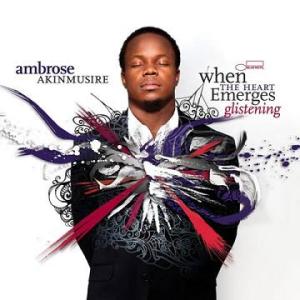
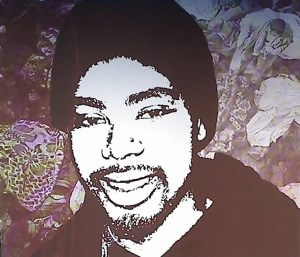
When listening to trumpeter Ambrose Akinmusire’s new album, When The Heart Emerges Glistening (Blue Note) I purposely skipped track 9, as a matter of practice.  “My Name is Oscar” is a tune written by the Oakland native in tribute to Oscar Grant III; an unarmed Black man who was murdered by a Bay Area Rapid Transit police officer.  The officer shot Grant in his back while he lay in a defenseless face-down position on the train platform in the early morning hours of New Years Day, 2009.  Being a New York native, and living through so much police brutality, it was a song I didn’t want to face.  But I did today.  I needed to face the song.  I’m not sure what compelled me to do this, but I knew that the murder had been documented by several witnesses, and I watched the video while listening to the song.  That was a good and a bad idea.  A bad idea simply because it was so very hard to watch (I had avoided the unbelievable horror of the footage until now).  But a good idea because it put the issue of police brutality in my face in a way I have never dealt with.  That’s not to say I had never seen Black men terrorized by the police.  Much to the contrary.  But I think dealing with Oscar Grant’s death was so important, especially living in a pseudo-post-racial society.  In the last three decades, I was able to reflect on the countless racially-inspired murders of Black people, committed by officers paid to serve and protect them.  Grant, Amadou Diallo, Timothy Stansbury Jr., Sean BellAiyana Jones and on and on and on and on and on…..

And just last week, The Pleasantville Police Benevolent Association honored the officer who shot and killed Danroy “D.J.” Henry, an unarmed, Black college football player in 2010.  The officer was honored for the “dignified and professional manner [he’s] conducted himself throughout his career and this ordeal.”

Killing Black men is dignified and professional in America.

Oscar Grant III

On “My Name is Oscar” drummer Justin Brown (also from Oakland) emits a brilliant and emotionally rousing performance while phrases like “live,” “don’t shoot” and “we are the same” echo in the folds of the solo.  When I listened to the song, it reminded me of how jazz has always narrated the human struggle.  From John Coltrane, to Max Roach to Branford Marsalis, and now to Mr. Akinmusire, jazz musicians have always been fearless about putting the Black struggle in the face of their audience.  This is the most commendable and important work.  To make people think differently about the world they live in, and to inspire change, is the best work.

Perhaps because I’ve seen this happen and go unpunished too many times to count. Perhaps because I have a brother named Oscar.  Perhaps because I’m raising a Black child in America.  Or probably because of all of the above…I must say that “My Name Is Oscar”  is one of the most important anthems of our generation.  Check out Mr. Akinmusire’s website, and he and his band are not to be missed whenever in your area.

Gil Noble: Jazz, Journalism, Lessons and Legacy

Rest in peace to the GREAT Gil Noble. A last name such as yours could not be more befitting. A great debt is owed you from not only the Black community, but the world. What would journalism be without you?

================================

Originally posted October, 2011

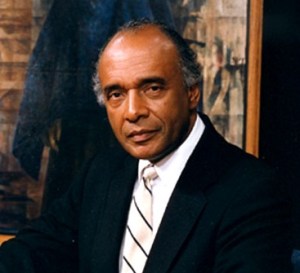
After 43 years on the air, last Sunday, ABC’s Like It Is came to a sudden and saddening end.  Emmy award winning producer and host Gil Noble suffered a stroke this past July, and the fate of the program had been subsequently undetermined. The last episode, which re-aired yesterday, was hosted by ABC newscaster Lori Stokes and featured Noble’s daughter Lisa, Danny Glover, Al Sharpton, journalists Bill McCreary and Les Payne, and New York City Councilman Charles Barron, who praised Noble’s maverick style of journalism, having profiled political prisoners like Assata Shakur and Mumia Abu Jamal.

Noble, who has interviewed some of the most prolific figures in American history, from Adam Clayton Powell, to Muhammad Ali, to Bob Marley, is known for being one of the most provocative journalists of our time. With Noble ultimately becoming unable to return to the public affairs program, ABC has created a replacement called Here and Now, which is receiving push back from the Black community for its seemingly half-hearted development.There is also concern that the new program, while promising to pay particular interest to topics relevant to the Black community, will not be in the same raw spirit, which is Noble’s legacy. If that’s to be so, it’s a real shame. There has been no other program that has given voice to the totality of Black America — politics, current and public affairs, arts, culture and more — than Like It Is.  Further, I can’t think of a journalist more progressive, introspective, and passionate than Gil Noble.  He was also the first image of a Black journalist that I had ever seen, which made an indelible impression on my conscious and subconscious young mind. Growing up watching Like It Is every week was as routine as afternoon football, church, or any other traditional Sunday activity. Being part of a household which nurtured both the arts, and social and cultural awareness, Like It Is was a reflection of my real life lessons and experiences, particularly as it pertained to jazz.

Noble, an accomplished pianist who initially pursued a career in music, is an avid jazz enthusiast. He has been on Jazz Foundation of America’s  Board of Directors for many years, and he frequently showcased musicians on his program. Unlike the comically short and non-comprehensive interview segments that are so typical when it comes to jazz profiles on television, Noble would dedicate his entire program to the likes of Oscar Peterson, Sarah Vaughan, Dizzy Gillespie, Abbey Lincoln, Dr. Billy Taylor, Lena Horne, Max Roach, Carmen McRae, Erroll Garner, and Wynton Marsalis. His narratives, in-depth and introspective, helped develop my broad view of how jazz musicians could be perceived. Noble presented jazz in journalism from a vantage unlike anyone else. He was not only a student and devotee of the music but a strong advocate for passing the traditions on to the next generations.

During his interview with Sarah Vaughan, she took him on a tour of her Newark, New Jersey home town, which included a stop by her elementary school. The children playing in the school yard of the building gravitate toward the cameras, and chat it up with the host and his iconic interviewee. As they begin to walk away, Noble stops in his tracks and addresses the students through the school’s gate. “Do you know who this lady is?” he asks. He then responds to the rounds of flat “Nos.”

“That’s part of the problem, isn’t it?” Noble’s blunt yet eloquent scrutiny was his signature. As he walks away he underscores, “If you don’t know who she is, when you go back to class, ask your music teacher who she is, and why she never told you about her.” It was not until adulthood that I realized how immensely crucial and precious this program was for that one example alone. That the likes of this type of education was reaching a network television audience every week remains monumental. So you can understand my elation to make his acquaintance about five years ago.

When trumpeter Charles Tolliver was preparing to release his big band album, With Love, he had a distinct vision for his project, down to the liner notes, which he implored Noble to write. Tolliver, who got his professional start through his friend and mentor, saxophonist Jackie McLean, wanted to pay homage in a personal way. Noble grew up with McLean in the Sugar Hill section of Harlem and they were best friends from childhood until McLean’s passing. Tolliver thought it would be most fitting and honorable if Noble would pen the notes for his Blue Note debut (which he did, beautifully).

Working on this album with Tolliver, I remember that blustery day, trekking up to ABC in the Lincoln Center vicinity to talk details with Mr. Noble and Mr. Tolliver. There were full circle moments to go around that day, for both Tolliver and myself. For me, meeting the man who inspired my perspective about jazz coverage in mainstream media would prove life-changing.
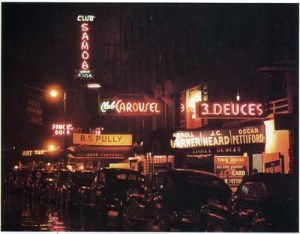
We sat in a waiting area before being ushered into Noble’s office. We waited about ten minutes for him to join us, during which time I timidly perused his immense library of books.  The room was adorned with African artifacts, artwork and posters, including the famed photo of 52nd Street nightlife in New York City, which was the hub for bebop in the 1940s.  When he entered the room, my stomach dropped. He is a tall man, but his presence was ten times that of his height. His demeanor is intensely quiet, similar to his on-air persona. He sat disarmingly relaxed behind his desk, and Tolliver and I opened the conversation.

We talked about music in a general way, about Tolliver’s project, but mostly about Jackie McCLean. J-Mac, as he was nicknamed, had just passed away and I could see the sadness in Noble’s eyes as he spoke of him.  The loss of his best friend was obviously hard and the vacancy in Noble’s heart was transparent. Noble talked about their childhood, their adventures together as teenagers, and he spoke specifically about the way drugs plagued the lives and careers of so many jazz musicians and how McLean, who suffered from and conquered drug addiction, educated him about the music industry as it related to the fragility of growing up Black in that era.  It was a conversation that I will never, ever, ever forget.  Getting a one-on-one education from Noble, in the presence of a jazz master in Charles Tolliver, discussing a giant in Jackie McLean was a beautiful and crucial experience. The climate of mainstream jazz journalism (and especially criticism) today is not only broadly monochromatic and misguidedly audacious, as usual, but technological advances give voice to virtually anyone who feels like being an authority on the subject, which isn’t always a good thing.  (Examples: Writers who haven’t lived as many years as some artists have had professional careers making proclamations about who is and isn’t innovative, or telling off the Black community of jazz musicians, blaming them for why they are being left out of critical dialogues.)

[Insert deep breath]

Additionally, writers seem to be writing for other writers, rather than using their platforms to work in tandem with the music and nurture a community at large which — fathom this — actually gives a damn.  The dangerous duo of ego and lack of diversity remains the affliction that keeps journalism in jazz from reaching full potential. Too many of these journalists have traditionally put themselves in front of the artists, and ahead of the music. Moreover, there is still a severe lack of proportion when it comes to editorial and coverage of African American jazz musicians.

What watching Gil Noble all of these years, and having that candid and personal conversation with him has taught me is infinite. But in more specific terms, what it taught me is that as a writer, especially a writer of color, I have to be passionate about truth.
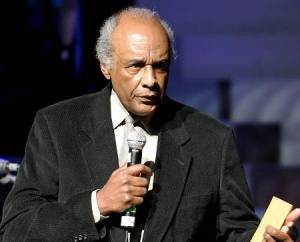
Tim Soter/WireImage

The beauty of being a writer, or of performing any artistic expression, is freedom. It is truly liberating. But as a Black person writing about a Black art form, which is mainly analyzed, critiqued and examined through the scope of white men, I have a duty beyond being poetic or inciting. There is another level of responsibility, and here is the essence of Noble’s genius. His depictions of artists were always supported with a social contextualization — let’s go back to his doubling-back to those students with that message about Sarah Vaughan. Jazz is one art form that cannot be written about it a bubble, because it is distinctively intertwined with a culture. Why this is a concept that is resisted and resented in journalism is bewildering to me.

But thank goodness for Gil Noble. He is my hero. Acutely informed with an immense amount of integrity and creativity, he has laid the groundwork that I can only hope to aspire to build upon. His passion for jazz, politics, and the scope of the African diaspora; and his ability to create a television program which successfully married these subjects for all audiences for decades, is most inspiring. Most importantly, his convictions spoke through his journalism. He didn’t have to spend time identifying who he is to his audience…it’s eloquently obvious in everything he produced. That’s class.

It is my hope that Like It Is will remain on the air somehow (perhaps through syndication, a-hem, a-hem, BET and TVOne, step up). Most importantly, I hope his wish for the program’s archives to be utilized in educational spaces comes to fruition. It is an unparalleled resource.

Like It Is debuted just two months after Dr. Martin Luther King Jr. was assassinated, and was largely inspired by this event. The last broadcast of Like It Is aired on the same day as Dr. King’s memorial dedication.